If you are thinking about selling your home in Virginia and wondering about taxes, you are not alone. As a knowledgeable real estate agent here in Richmond, I often get this question. The short answer: maybe, but often not or not fully, depending on your situation. In this post, I will walk you through how it works at both the federal and state levels, what could trigger a tax bill, and what smart sellers do to minimize or avoid taxes.
🏡 Federal Taxes on Your Home Sale
Capital Gains Exclusion
The IRS explains: “If you have a gain from the sale of your main home, you may be able to exclude up to $250,000 of that gain from your income. Taxpayers who file a joint return with their spouse may be able to exclude up to $500,000.” (IRS Topic 701)
To qualify for this exclusion, you must meet the following requirements:
Ownership test: “You must have owned the home for at least 2 years during the 5-year period ending on the date of the sale.” (IRS Topic 701)
Use test: “You must have lived in the home as your main home for at least 2 years during the 5-year period ending on the date of the sale.” (IRS Topic 701)
Two-Year Rule for Multiple Sales
The IRS clarifies: “You cannot take the exclusion if you excluded gain from the sale of another home during the 2-year period prior to the sale of your current home.” (IRS Topic 701)
Calculating Your Gain
The IRS explains:
“If the amount you realize on the sale of your home … less your selling expenses, is more than your adjusted basis in your home, you have a capital gain on the sale.” (IRS FAQ)
“Your adjusted basis is your cost in acquiring your home plus the cost of any capital improvements you made, minus certain decreases.” (IRS FAQ)
Selling expenses such as broker commissions and closing costs are subtracted from the amount realized to determine taxable gain. (IRS Publication 523)
If you meet all the conditions and have not sold another home within the prior two years, a large portion, or even all, of your gain may be tax-free.
🏛️ Virginia State Taxes
Virginia treats capital gains as ordinary income. (Virginia Department of Taxation)
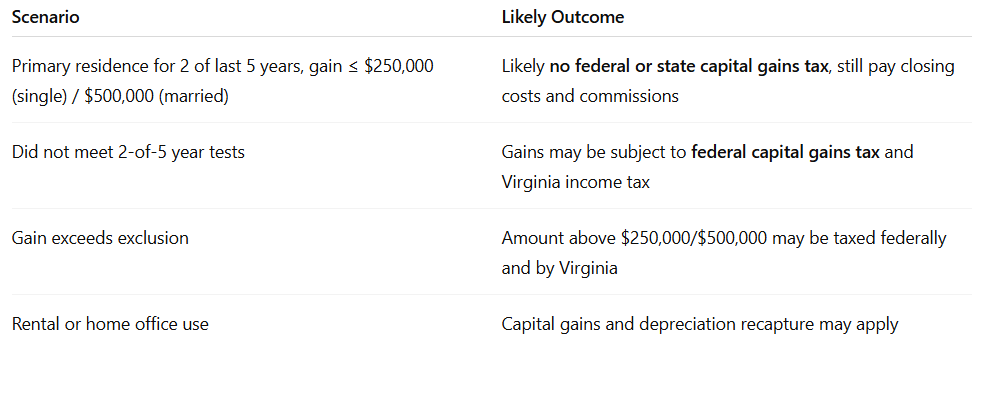
If you qualify for the federal exclusion, that exclusion generally applies in Virginia as well. This means you likely will not owe state tax on gains below $250,000 (single) or $500,000 (married joint).
Gains exceeding these thresholds may be taxed at Virginia’s state income tax rate, up to 5.75 percent.
📉 Other Seller Costs to Budget
Even if your sale is tax-exempt, selling a home in Virginia typically includes other costs:
Grantor and recording taxes, typically about $1 per $1,000 of sale price (Bankrate)
Prorated property taxes owed through the closing date (Virginia Beach)
Accurately calculating your adjusted basis and all expenses is crucial for determining net proceeds.
✅ Typical Scenarios
🧠 Tips to Maximize Your Net Proceeds
Document all improvements, purchase costs, and selling expenses
Meet the 2-of-5 year test whenever possible
Wait two years between sales if you’ve claimed the exclusion previously (IRS Topic 701)
Budget for commissions and closing costs
Consult a CPA if the property was a rental or investment
🎯 Expert Guidance for Virginia Home Sellers
If you are selling in Richmond, Chesterfield, Henrico, or surrounding areas, I can help you:
Calculate your net proceeds before and after taxes
Plug in realistic commissions, grantor/recordation taxes, and prorated property taxes
Connect you with a trusted CPA familiar with Virginia home sales
Ready to Sell Your Home in Richmond, Chesterfield, Henrico or the Surrounding Areas
If you want a smooth stress free sale with expert guidance every step of the way Don Reid Properties is here to help. Whether you are planning to sell soon or just exploring your options we can walk you through pricing strategy market timing tax considerations and what your home could realistically sell for in today’s market.
📲 Schedule your free home value consultation today
Call or text 804 929 4475
Or visit www.donreidproperties.com
Your home sale should feel confident clear and profitable. Let’s make that happen.
Disclaimer
This information is provided for general educational purposes only and should not be considered tax legal or financial advice. Tax laws can change and individual situations vary. Before making any decisions about selling your home or determining potential tax obligations you should consult with a licensed tax professional CPA or financial advisor. Don Reid Properties does not provide tax or legal services.